Search...

Κυριακή 4 Απριλίου 2021

[EN] EU LAWMAKER CALLS FOR PROCEDURE AGAINST GREECE OVER MIGRANT TREATMENT AT TURKISH BORDER

INFOMIGRANTS
Benjamin Bathke

Groups of migrants on Turkey's Pazarkule border to Greece stand behind rolls of barbed wire | Photo: A.Avramidis/Reuters


A year after the deadly clashes between migrants and Greek border guards at the Greek-Turkish border, EU lawmaker Erik Marquardt has called on the bloc to launch infringement proceedings against Greece over alleged human rights abuses against migrants.

Had the bullet hit him slightly higher or lower, he wouldn't be alive today. That's what a doctor told him a year ago at the Greek-Turkish border, Syrian Muhammad Hantou told German news agency dpa.

Hantou was shot when he, like thousands of others, tried to cross into the EU. Grey scars reveal the injury at his ear, which still impairs him. Sometimes he's dizzy, and he cannot concentrate very long, he says.

On February 28 last year, Turkey declared it was "no longer able to hold refugees", leading to thousands of migrants travelling to that border to try to reach Europe. They were pushed back by Greek border guards, including with tear gas, stun grenades and batons.

Criticism from EU lawmaker

The incidents at the border in February 2020 amount to a "systematic violation of EU law," Erik Marquardt, a member of the European Parliament for the Green party, told dpa on Sunday.

Marquardt cited examples such as shots fired at the border, so-called pushbacks, suspension of asylum procedures and violations of the directive on reception of applicants for international protection.

Marquardt said the European Commission is the "guardian of the treaties, and this means if EU law is broken so obviously, then we need an infringement procedure." Member states should not just "sugar-coat human rights violations" but find a "plain language" to address Greece, he added.
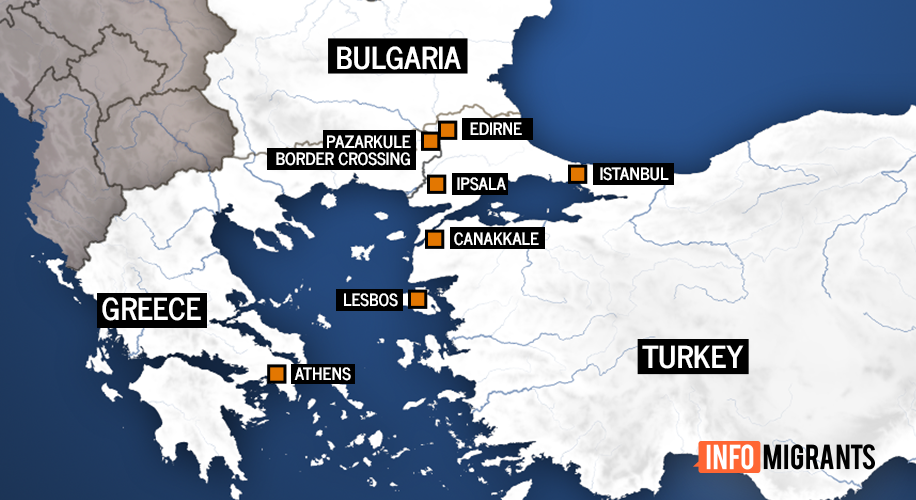
Map of Turkey-Greece-Bulgaria border region | Credit: InfoMigrants


Deadly clashes at the border

According to dpa, "(I)nternational research teams have found that live ammunition was very likely also used by the guards." In the end, at least two migrants died: The Syrian Muhammad al-Arab and the Pakistani Muhammad Gulzar. According to Amnesty International, a Syrian woman is presumed missing.

The Turkish government has said that its Greek counterpart is responsible for the death of the three migrants, which the Greek government denies. Greek authorities told dpa that the incidents at the beginning of March 2020 involved a "threat to national security." They said the accusations of illegal actions were "tendentious," and such actions were not part of the practices of Greek authorities.

Soon after migrants arrived at the border, Greece and Turkey engaged in a proxy war on social media over what is happening on their border, with both sides accusing each other of carrying out abuses and spreading fake news.

After camping out at the border for weeks and trying in vain to cross the border, Turkish authorities sent the some 6,000 migrants to cities inside Turkey at the end of March.

What exactly happened at the Greek-Turkish border in early March 2020 remains unclear. EU lawmaker Erik Marquardt called it "shocking" that there haven't been any consequences. "I had expected the outcry to be a lot bigger," he said.
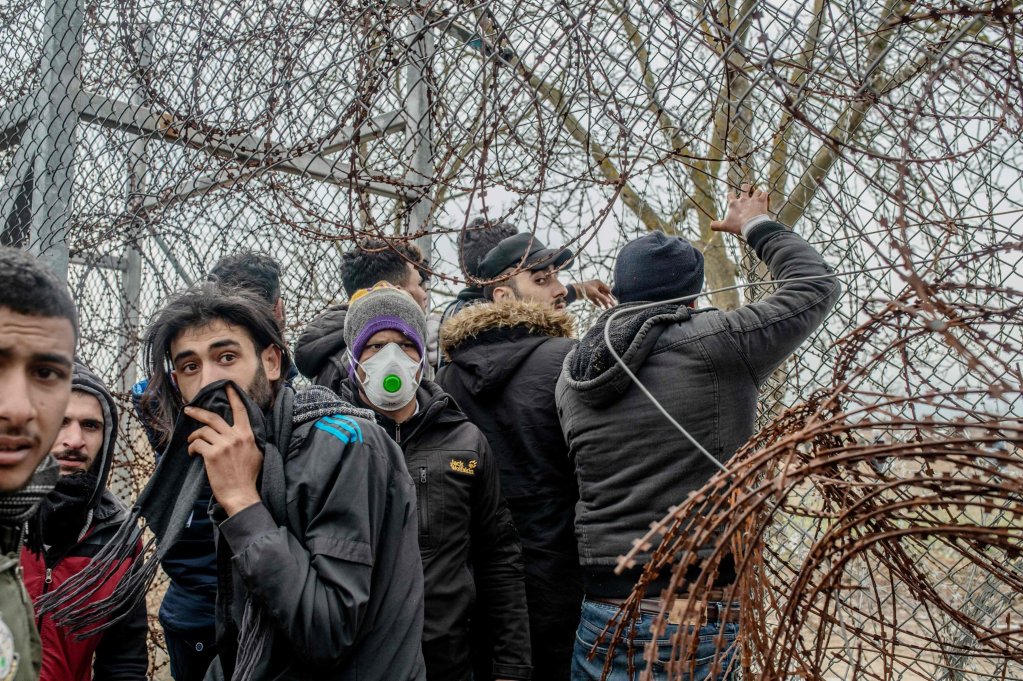
Migrants in the buffer zone at the Turkey-Greece border try to remove fences near the Pazarkule crossing in Edirne, March 4, 2020 | Photo: B. Kilic/AFP

Shattered dreams

Last year's events continue to affect not only the EU's migration policy, but also the life of Muhammad Hantou. It was his third attempt to reach Europe, he says. His first two attempts, both via boat, failed, reports dpa.

He told dpa he wanted to reach the Netherlands since his then-girlfriend was living there and they wanted to get engaged. Before the war in Syria, they were neighbors. When Hantou heard that the borders were supposedly open, he boarded a bus in Istanbul.

The conditions at the border were chaotic, he remembers. Greek border guards used tear gas, while migrants threw stones and some cut holes into the border fence. "The moment I put a foot into one of the holes, they shot," he told dpa, referring to the Greek side.

Hantou remembers being dragged to the ambulance. According to the medical report, which dpa has seen, bullets from a firearm injured him. There was a bullet hole at his right ear -- one bullet is still stuck in his skull.
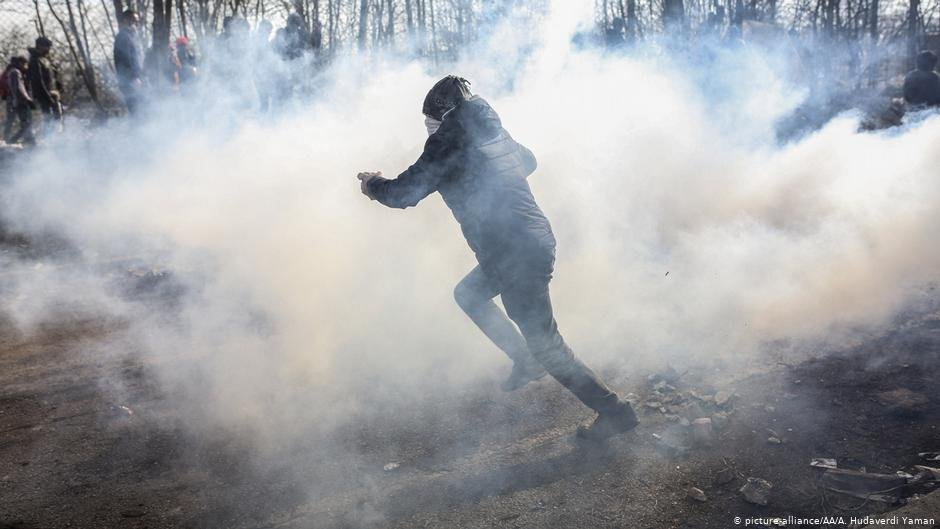
A migrant runs as Greek security forces intervene at the border between Turkey and Greece | Photo: Picture-alliance/AA/A.Hudaverdi Yaman


"Sometimes, when I go to sleep, I feel pain in this part. Sometimes I'm scared of falling or it getting infected and making everything worse," Hantou says.

Technically, he needs surgery, but he only spent one week in hospital. For the past three months, he has been cleaning dishes. Two lawyers are taking care of Hantou's case, but they weren't able to file a complaint yet due to the COVID-19 pandemic, the Greek lawyer told dpa.

Millions of migrants stuck in Turkey

Some four million refugees and migrants currently call Turkey home, the largest number of all host countries, including 3.6 million Syrians. According to the so-called EU-Turkey deal from 2016, Turkey has committed to stopping irregular migration to Europe in return for financial support.

But times and again, Turkish President Recep Tayyip Erdogan uses the deal to pressure the EU. Observers say aforementioned declaration that Turkey was "no longer able to hold refugees" a year ago was an example of this to force the EU to provide more support.

with dpa


1/3/2021

https://www.infomigrants.net/en/post/30561/eu-lawmaker-calls-for-procedure-against-greece-over-migrant-treatment-at-turkish-border


[EN] EUROPE: PUSHBACK PRACTICES AND THEIR IMPACT ON THE HUMAN RIGHTS OF MIGRANTS AND REFUGEES – AMNESTY INTERNATIONAL SUBMISSION TO THE UNITED NATIONS (UN) SPECIAL RAPPORTEUR ON THE HUMAN RIGHTS OF MIGRANTS, FEBRUARY 2021


In response to the questionnaire of the Special Rapporteur on the human rights of migrants on “pushback practices and their impact on the human rights of migrants”, this document provides Amnesty International's input on select patterns of pushbacks of migrants and refugees in Europe with a focus on Bosnia-Herzegovina, Croatia, Cyprus, France, Greece, Italy, Malta, Slovenia and Spain. This submission is largely based on previously published research by Amnesty International, links to which are available in the Annex.


View report in English

DOWNLOAD PDF


[EN] IOM CALLS FOR END TO PUSHBACKS AND VIOLENCE AGAINST MIGRANTS AT EU EXTERNAL BORDERS


Geneva– The International Organization for Migration (IOM) is calling on the European Union (EU) and its Member States to take urgent action to end pushbacks, collective expulsions, and the use of violence against migrants and refugees, including children, at the EU’s external land and maritime borders. 

IOM continues to receive documented reports of human rights violations and breaches of international law and its conventions, including the European Convention on Human Rights. Our direct interactions, with migrants – including during the delivery of assistance –, as well as various testimonies and photographs shared by NGOs and the media, confirm the level of brutality they were subjected to before being pushed back across maritime and land borders.

“The use of excessive force and violence against civilians is unjustifiable,” says IOM Chief of Staff Eugenio Ambrosi.

“States’ sovereignty – including their competence to maintain the integrity of their borders – must be aligned with their obligations under international law and respect the human rights and fundamental freedoms of all.”

Pushbacks and collective expulsions are prohibited under international and EU law, and IOM condemns in the strongest terms the abuse of migrants and refugees at any border. 

The Organization welcomes recent investigations initiated by several states and EU bodies into allegations of pushbacks, violations of the principle of nonrefoulement, as well as violence at borders, and stresses that action needs to be taken by states to put an end to these abuses. 

The alarming situation at some of the EU’s external borders highlights the need to improve migration and asylum policy and governance, and implement humane and integrated rights-based practices.

IOM welcomes the proposal by the European Commission – set out in the new Pact on Migration and Asylum, currently under negotiation – that EU Member States establish an independent border monitoring mechanism, working closely with the Fundamental Rights Agency, as an effective way to ensure accountability and compliance with international and EU laws. 

IOM continues to offer its support to the EU and its Member States on migration governance, including capacity building for rights-based integrated border management that respects the human rights of all migrants. 


For more information please contact: 

In Geneva, Safa Msehli, Tel: +41 79 403 5526. Email: smsehli@iom.int 

In Brussels, Ryan Schroeder Tel + 32 492 25 02 34. Email: rschroeder@iom.int 

In Vienna, Joe Lowry, Tel +43 660 377 6404. Email: jlowry@iom.int


9/2/2021

https://www.iom.int/news/iom-calls-end-pushbacks-and-violence-against-migrants-eu-external-borders

Τρίτη 2 Μαρτίου 2021

[EN] UNHCR WARNS ASYLUM UNDER ATTACK AT EUROPE'S BORDERS, URGES END TO PUSHBACKS AND VIOLENCE AGAINST REFUGEES


Shoes, a ball and a hat caught on a three layered barbed-wire fence at the Fylakio reception and identification centre near the Greek-Turkish border.  © UNHCR/Achilleas Zavallis

Alarmed at the increasing frequency of expulsions and pushbacks of refugees and asylum-seekers at Europe’s land and sea borders, UNHCR, the UN Refugee Agency, is calling for states to investigate and halt these practices.

“UNHCR has received a continuous stream of reports of some European states restricting access to asylum, returning people after they have reached territory or territorial waters, and using violence against them at borders,” said UNHCR’s Assistant High Commissioner for Protection, Gillian Triggs.

“The pushbacks are carried out in a violent and apparently systematic way. Boats carrying refugees are being towed back. People are being rounded-up after they land and then pushed back to sea. Many have reported violence and abuse by state forces.”

People arriving by land are also being informally detained and forcibly returned to neighboring countries without any consideration of their international protection needs.

The 1951 Refugee Convention, the European Convention on Human Rights and EU law require states to protect the right of people to seek asylum and protection from refoulement, even if they enter irregularly. Authorities cannot automatically deny entry to or return people without undertaking an individual assessment of those in need of protection.  

“Respecting human lives and refugee rights is not a choice, it’s a legal and moral obligation. While countries have the legitimate right to manage their borders in accordance with international law, they must also respect human rights. Pushbacks are simply illegal.” said Triggs.

“The right to seek asylum is a fundamental human right. The COVID-19 pandemic provides no exception; it is possible to protect against the pandemic and to ensure access to fair and speedy asylum processes.”

UNHCR has made its concerns clear to European states. The refugee agency calls for urgent inquiries into alleged violations and mistreatment based on credible testimonies that are corroborated by non-governmental organizations, media and open-source reporting.

“We advocate for national independent monitoring mechanisms to be set up to ensure access to asylum, to prevent rights violations at borders, and to ensure accountability. Independent monitoring is also proposed by the EU Pact and we urge EU Member States to support this”, said Triggs.

Numbers of arrivals to the EU continue to decrease each year. The numbers of those arriving by sea and land in 2020 (95,000) decreased by 23 per cent when compared with 2019 (123,700 individuals) and by 33 per cent when compared with 2018 (141,500).

“With so few arrivals to Europe, this should be a manageable situation. It is regrettable that the issue of asylum remains politicized and divisive despite such declining numbers.”

UNHCR recognizes that some states carry a disproportionate responsibility in hosting new arrivals. UNHCR calls on other European States and the EU to demonstrate solidarity by supporting them.

UNHCR also calls on European countries to uphold their existing commitments to refugee protection by admitting asylum-seekers at their borders, rescuing them at sea and allowing disembarkation and registering and supporting new asylum seekers.

UNHCR stands ready to assist states in meeting these international asylum obligations. 


For more information on this topic, please contact:

  • In Geneva (Global), Shabia Mantoo, mantoo@unhcr.org, +41 79 337 76 50
  • In Europe, please consult the full list of UNHCR spokespeople here

28/1/2021


Πέμπτη 25 Φεβρουαρίου 2021

[EN] BORDER VIOLENCE MONITORING NETWORK: BALKAN REGION REPORT – JANUARY 2021


BALKAN REGION REPORT – JANUARY 2021

MONTHLY REPORT ON PUSHBACKS

In January, the Border Violence Monitoring Network (BVMN) reported on 21 illegal pushbacks, affecting 684 people in total. This report summarises the latest trends in border policing and provides updates from across the Balkans on violence being perpetrated against people-on-the-move. Specifically, patterns in pushback practice are examined alongside several important court rulings and EU level developments.

As a network comprised of grassroots organisations active in Greece and the Western Balkans, this report was produced via a joint-effort between Are You Syrious, Mobile Info Team, No Name Kitchen, Rigardu, Josoor, Disinfaux Collective, InfoKolpa, Centre for Peace Studies, Re:ports Sarajevo, Mare Liberum, Collective Aid and Fresh Response.

This report analyses among other things:

  • Practices at the Romanian border
  • Lateral pushbacks to third countries
  • Court rulings from Italy, Slovenia and Serbia
  • Frontex leaving Hungary
  • Geography of Evros/Meriç river pushbacks

The publication also looks in depth at the transit situation in the Balkans, analysing the conditions in camps, urban spaces, detention centres and border areas. When combined, these updates represent a crude and inhumane start to 2021, but one that is consistent with the violent border regimes that have defined recent years.

17/2/2021

https://www.borderviolence.eu/balkan-region-report-january-2021/

[EN] BORDER VIOLENCE MONITORING NETWORK: BALKAN REGION REPORT – DECEMBER 2020


BALKAN REGION REPORT – DECEMBER 2020

During December 2020, the Border Violence Monitoring Network (BVMN) gathered 25 testimonies of pushbacks, impacting a total of 707 people-on-the-move. This rounds off a year of consistent and compelling evidence collected by BVMN, exposing the systematised use of pushbacks at the European Union external border. In this report, updates cover a variety of violations including pushback practices, internal violence and the crisis around winterised shelter.

As a network comprised of grassroots organisations active in Greece and the Western Balkans, this report was produced via a joint-effort between Are You Syrious, Mobile Info Team, No Name Kitchen, Rigardu, Josoor, Disinfaux Collective, InfoKolpa, Centre for Peace Studies, Re:ports Sarajevo, Mare Liberum, Collective Aid and Fresh Response.

This report analyses among other things:

    • Tri-border pushbacks from Bulgaria to Turkey
    • Expulsion of transit groups from Lesvos
    • Fire pits used by the Croatian police
    • The burning of camp Lipa in Bosnia-Herzegovina
    • Legal proceedings against Croatia and Hungary
    • Gateway removals near Idomeni

Read the full report to find out more about these, and further events from the region that occured in December. Other topics include an update from activists working with arrivals in Trieste, analysis of Greek Ministry of Asylum videos, coverage of right wing attacks in Thessaloniki and fires on Samos, and challenging transit conditions for people in Serbia as winter intensifies.

15/1/2021


[EN] BORDER VIOLENCE MONITORING NETWORK: BALKAN REGION REPORT – NOVEMBER 2020


BALKAN REGION REPORT – NOVEMBER 2020

The Border Violence Monitoring Network published 29 testimonies of violent pushbacks in November, involving severe levels of physical, psychological and structural abuse. The testimonies collected last month voice the experience of 951 people-on-the-move. This report offers analysis of the trends observed in each of these accounts, showing how law enforcement carry out these violent collective expulsions at EU borders.

As a network comprised of grassroots organisations active in Greece and the Western Balkans, this report was produced via a joint-effort between Are You Syrious, Mobile Info Team, No Name Kitchen, Rigardu, Josoor, Disinfaux Collective, InfoKolpa, Centre for Peace Studies, Re:ports Sarajevo, Mare Liberum, Collective Aid and Fresh Response.

This report analyses among other things:

  • The stranding of transit groups on the Evros/Meriç River and Aegean Sea
  • A groundbreaking video analysis of a Croatian pushback
  • Violent sea and land removals from Italy
  • Denial of asylum access for people from LGBTQ+ community
  • Detention in Bulgaria and chain pushbacks to Turkey

The report also looks at the transit situation in Greece, Bosnia-Herzegovina and Serbia, as well as reviewing the arrival conditions for people in North East Italy. The onset of winter has come with a spike in squat evictions, and uncertainty about the present accomodation provision across these countries. With police pressure on transit communities and the solidarity groups supporting them, the close of 2020 is being marked with a further erosion of rights in the region.

15/12/2020

https://www.borderviolence.eu/balkan-region-report-november-2020/#more-16536


[EN] BORDER VIOLENCE MONITORING NETWORK: BALKAN REGION REPORT – OCTOBER 2020


BALKAN REGION REPORT – OCTOBER 2020


In October, the Border Violence Monitoring Network published 40 reports of pushbacks and police violence at European Union borders. These cases, which relate the experience of 1003 people-on-the-move, are a testament to the brutal border systems in place at internal and external EU borders. Respondents experienced a range of physical, psychological and structural violence, which is examined in detail in this report.

As a network comprised of grassroots organisations active in Greece and the Western Balkans, this report was produced via a joint-effort between Are You Syrious, Mobile Info Team, No Name Kitchen, Rigardu, Josoor, InfoKolpa, Centre for Peace Studies, Re:ports Sarajevo, Mare Liberum, Collective Aid and Fresh Response.

This report analyses among other things:

  • Police violence and incidents of rape at the Croatian border
  • Organised pushbacks from inland Greece
  • Abuse at Italy’s maritime and land borders
  • Ban on outreach in Bosnia-Herzegovina
  • Anti-migrant protests in Serbia and Italy
  • Pushbacks from Hungary

Read the full report for further updates on the criminalisation of solidarity work in Croatia, forced removals to the South of Serbia, Frontex pushbacks in the Aegean and deaths of people-on-the-move killed on the route last month.


17/11/2020

https://www.borderviolence.eu/balkan-region-report-october-2020/

Κυριακή 31 Ιανουαρίου 2021

Η «ΜΑΥΡΗ ΒΙΒΛΟΣ» ΤΟΥ ΠΡΟΣΦΥΓΙΚΟΥ ΚΑΙ ΤΩΝ ΕΠΑΝΑΠΡΟΩΘΗΣΕΩΝ


Η «Μαύρη Βίβλος» του προσφυγικού, ένα ογκώδες έργο 1.500 σελίδων στο οποίο περιλαμβάνονται τεκμήρια από εκατοντάδες παράνομες επαναπροωθήσεις αιτούντων άσυλο από τις ευρωπαϊκές αρχές, κυκλοφόρησε την περασμένη εβδομάδα στις Βρυξέλλες και παραδόθηκε στην Κομισιόν.

Το «Black Book of Pushbacks», όπως ονομάζεται, συντάχθηκε από τον οργανισμό Border Violence Monitoring Network (BVMN) και αποτελεί μια συλλογή από 892 μαρτυρίες ομάδων, που περιγράφουν λεπτομερώς τις εμπειρίες 12.654 θυμάτων παραβιάσεων των ανθρωπίνων δικαιωμάτων κατά τη διαδρομή τους στον λεγόμενο «βαλκανικό δρόμο» στη διάρκεια της προσφυγικής κρίσης των τελευταίων ετών.

«Η ‘Μαύρη Βίβλος’ με τις μαρτυρίες παράνομων επαναπροωθήσεων είναι συγκλονιστικό με την έννοια της συλλογής σχεδόν 13.000 μαρτυριών από συνανθρώπους μας που έχουν βάναυσα τρομοκρατηθεί και σε πολλές περιπτώσεις κακοποιηθεί από χώρες της λεγόμενης βαλκανικής οδού μεταξύ των οποίων και η Ελλάδα η οποία το τελευταίο διάστημα έχει συστηματοποιήσει τη παράνομη αυτή διαδικασία. Σε αυτές τις διαδικασίες συμμετέχει και η Frontex και άλλες ευρωπαϊκές υπηρεσίες πέραν των ελληνικών αρχών όπως αστυνομία και στρατός και το λιμενικό σώμα», δήλωσε ο Επαμεινώνδας Φαρμάκης, ιδρυτής της ΜΚΟ HumanRights360.

«Ακόμα και ανήλικα παιδιά έχουν παράνομα επιστραφεί στη Τουρκία ή έχουν αφεθεί σε μια σχεδία ανοικτά στη θάλασσα. Αυτές οι εγκληματικές και απάνθρωπες ενέργειες πρέπει να σταματήσουν! Ελπίζουμε ότι αυτή η συλλογή των μαρτυριών θα κινητοποιήσει επιτέλους την ΕΕ να απαιτήσει περισσότερη διαφάνεια από κράτη μέλη όπως η Ελλάδα και να επιβάλλει κυρώσεις ώστε να σταματήσουν αυτές οι παράνομες διαδικασίες».

Κάθε μέρα χιλιάδες άνθρωποι, κυρίως από τη Νότια Ασία, τη Μέση Ανατολή και τη Βόρεια Αφρική, προσπαθούν να διασχίσουν τα Βαλκάνια για να φτάσουν στην Ευρώπη. Πρόκειται για ένα βασανιστικό ταξίδι, στο οποίο οι άνθρωποι αναγκάζονται να περάσουν το μεγαλύτερο μέρος του ταξιδιού σε αυτοσχέδια στρατόπεδα ή σε σιδηροδρομικούς σταθμούς.

Εδώ και χρόνια οι φιλανθρωπικές οργανώσεις καταγγέλλουν τις πολιτικές των κρατών υποδοχής και μεταφοράς, καθώς οι αιτούντες άσυλο ξυλοκοπούνται, ληστεύονται και δέχονται βία συστηματικά. Μεταξύ Ιανουαρίου και Νοεμβρίου 2020, το Δανέζικο Συμβούλιο Προσφύγων (Danish Refugee Council) κατέγραψε 15.672 επαναπροωθήσεις από την Κροατία προς τη Βοσνία-Ερζεγοβίνη, με πάνω από το 60% αυτών να γίνεται με άσκηση βίας.

«Αυτό το βιβλίο – στο οποίο συγκεντρώνουμε τέσσερα χρόνια μελέτης και καταγραφής περιστατικών – επισημαίνει το μεγάλο κενό στην καταγραφή περιστατικών καταπάτησης των ανθρωπίνων δικαιωμάτων από κρατικές και ευρωπαϊκές αρχές, όπως ο Frontex», δήλωσε ο Σιμόν Κάμπελ, συντονιστής της έκδοσης. «Οι μαρτυρίες που έχουμε καταγράψει αποτελούν ένα σημαντικό φάκελο με πλούτο αποδεικτικών στοιχείων. Περιγράφουν λεπτομερώς τις συστηματικές ενέργειες εναντίον ανθρώπων που αναζητούν ένα καλύτερο αύριο και αιτούνται άσυλο, περιλαμβάνει παραβιάσεις του διεθνούς δικαίου για το άσυλο και τις επιαναπροωθήσεις, καθώς και παραβιάσεις που βρίσκονται στον πυρήνα του Χάρτη των Ανθρωπίνων Δικαιωμάτων, όπως τα βασανιστήρια και οι εκβιασμοί».

Περισσότεροι από 15 οργανισμοί έχουν συνεισφέρει σε αυτή την έκδοση, που περιέχει χάρτες, ντοκουμέντα, φωτογραφικό υλικό και άλλες βασικές πληροφορίες. Η έκδοση πραγματοποιήθηκε με τη συμβολή και στήριξη της ευρωομάδας της Αριστεράς στο Ευρωπαϊκό Κοινοβούλιο.

Η Μάλιν Μπγιόρκ και ο Μιγκέλ Ουρμπάν κρατώντας τον πρώτο και δεύτερο τόμο της έκδοσης, πριν τους παραδόσουν στην Επίτροπο Ίλβα Γιόχανσον, στις Βρυξέλλες. Credit: Quentin Bruno/The Left.

Η ευρωβουλεύτρια Μάλιν Μπγιόρκ, μέλος της επιτροπής πολιτικών ελευθεριών, δικαιοσύνης και εσωτερικών υποθέσεων του Ευρωπαϊκού Κοινοβουλίου και ο Μιγκέλ Ουρμπάν, εκ των συνιδρυτών των Podemos, παρουσίασαν και παρέδωσαν την «Μαύρο Βίβλο» στην Επίτροπο της ΕΕ για το Άσυλο, Ίλβα Γιόχανσον, στις Βρυξέλλες.

Μιλώντας για τη δημοσίευση της έκδοσης, η Γερμανίδα ευρωβουλεύτρια Κορνήλια Ερνστ σημείωσε ότι «Είμαστε σοκαρισμένοι από τις καταθέσεις και τις περιγραφές ανελέητης, σαδιστικής και εξευτελιστικής βίας, που θυμίζουν πρακτικές δικτατορικών καθεστώτων. Η έκδοση αυτή ρίχνει φως σε αυτό το σκοτεινό κεφάλαιο της ΕΕ. Η ελπίδα μας είναι ότι θα συμβάλει στον τερματισμό αυτών των εγκλημάτων και στην απόδοση ευθυνών στις κυβερνήσεις που δρουν με τέτοιο ντροπιαστικό, παραβατικό και βίαιο τρόπο κατά ανθρώπων».

«Αν και οι αρχές και κυβερνήσεις αρνούνται καθετί που περιέχεται στην έκδοση, εμείς από την πλευρά μας έχουμε αναλυτικά στοιχεία που τεκμηριώνουν αυτές τις παράνομες ενέργειες», δήλωσε ο Χόουπ Μπάρκερ, εκπρόσωπος της BVMN. «Φανταστείτε ότι αυτές είναι μόνο οι ιστορίες που το δίκτυό μας κατάφερε να ηχογραφήσει. Η πραγματικότητα είναι πολύ πιο σκοτεινή και οι υποθέσεις πολύ περισσότερες».


26/12/2020

https://rosa.gr/i-mayri-vivlos-toy/